VISTA, TCC-CIMET and KNUST Join Forces with MIT D-Lab to Transform Aquatic Weeds into Opportunities for Communities
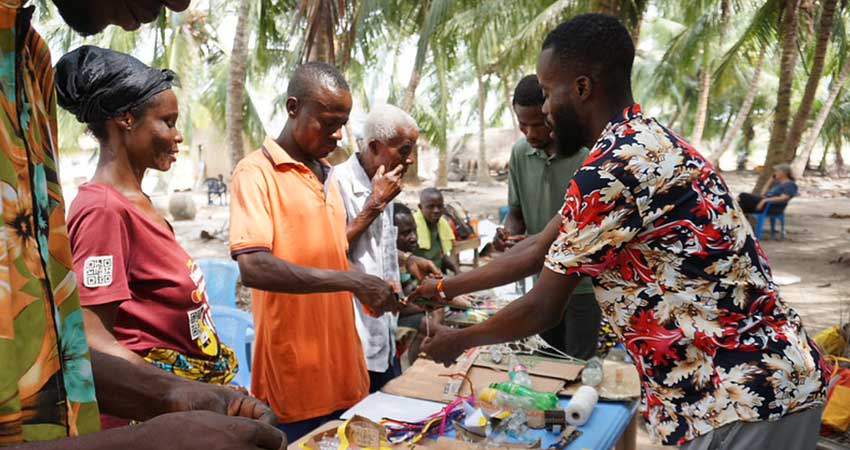
In 2023, a simple question sparked an idea that would grow into a collaborative effort to address one of the environmental challenges facing communities along Ghana’s Lower Volta: how can communities tackle the growing problem of aquatic weeds?
The question prompted stakeholders to consult researchers from the Massachusetts Institute of Technology’s D-Lab (MIT D-Lab) on possible ways to address the spread of aquatic weeds in the region. What began as a conversation about an environmental challenge soon evolved into an opportunity to explore community-driven innovation.
At the heart of this approach is the philosophy championed by Amy Smith, founding director of MIT D-Lab and founder of the International Development Design Summit (IDDS). Through D-Lab, Smith has advanced collaborative approaches that bring communities and technical experts together to develop practical solutions to challenges affecting people’s lives.
This philosophy provides important context for the emergence of the Volta Invasive Species Transformation Alliance (VISTA), which brings together local and technical expertise to explore responses to invasive aquatic weeds in Ghana’s Volta River basin. Working in collaboration with the Technology Consultancy Centre for Innovation, Manufacturing, Technology Transfer and Entrepreneurship (TCC-CIMET) at Kwame Nkrumah University of Science and Technology (KNUST), the initiative seeks to harness technological innovation and community participation to address the challenge.
Dan Sweeney, co-founder of VISTA and a member of the MIT D-Lab team, explained that the initiative provides a platform for working directly with communities to identify their technological needs and develop solutions that respond to their challenges.
“The idea is to work alongside communities to understand the challenges they face, identify their technological needs and develop practical solutions together. Rather than bringing in solutions from outside, we want to engage communities in the process so that the technologies developed are relevant to their needs and circumstances.”
This community-centred approach places local people at the heart of the innovation process, recognising that their knowledge and experiences are essential to developing technologies that are practical, appropriate and sustainable. Through the collaboration, MIT D-Lab’s community-driven design approach can be brought together with TCC-CIMET and KNUST’s expertise in technology development, fabrication and the adaptation of innovations to local needs.
For communities along the Lower Volta, the spread of water hyacinth presents significant environmental and economic challenges. The invasive plant can obstruct waterways, interfere with fishing and transportation, and create difficulties for communities that depend on the river for their livelihoods. Finding effective ways to manage the weed is therefore important not only for the environment but also for the economic well-being of affected communities.
VISTA emerged as a platform through which these challenges could be explored using collaborative design and technological innovation. The initiative connects community participation with research and practical experimentation, encouraging stakeholders to move beyond managing the weed as a nuisance and investigate ways to transform it into a useful resource.
One area of exploration is the conversion of harvested water hyacinth into charcoal, potentially providing an alternative source of fuel while creating opportunities to derive value from the invasive plant. Such approaches could contribute to reducing the weed’s accumulation in waterways while opening up possibilities for local enterprise and income generation.
The involvement of TCC-CIMET and KNUST is significant in exploring how technological ideas can be developed, adapted and potentially translated into practical applications. Through its focus on innovation, manufacturing, technology transfer and entrepreneurship, TCC-CIMET offers a platform for investigating the technical requirements of potential solutions and exploring how they might be developed for community use.
The collaboration also highlights the importance of bringing together different forms of expertise. While researchers contribute scientific and technical knowledge, local communities provide first-hand understanding of the problem, and institutions such as TCC-CIMET and KNUST can help explore the technologies and processes required to turn ideas into practical solutions.
Ultimately, the story of VISTA demonstrates how a question about a pressing local challenge can develop into a broader collaborative effort. By bringing together MIT D-Lab, TCC-CIMET, KNUST and affected communities, the initiative seeks to create opportunities for locally relevant innovation that addresses environmental concerns while exploring potential social and economic benefits.
At its core, VISTA reflects a simple but powerful principle: sustainable solutions are more likely to emerge when communities are not merely recipients of technology, but active partners in identifying problems, designing solutions and determining what works for them.
Was this article helpful?
TCC-CIMET
AdminStay up to date with what's happening at TCC-CIMET and within the KNUST community
Related post:
- TCC-CIMET, Engineering Council, Ghana, Russian Mining Engineers Association Advance Framework for Professional Certification of Mining Engineers in Africa
- TCC-CIMET Calls for Harmonized Certification and Professional Recognition of Mining Engineers in Africa
- TCC-CIMET, DAAD explore digital pathways for circular construction in Africa
- TCC-CIMET, AESD Explore Collaboration to Strengthen Agricultural Technology Development in Ghana
- Prof. Agyare Assumes Chairmanship of TCC-CIMET Governing Board, Strengthening UNESCO, Ghana, KNUST Partnership
- Prof. Agyare Pledges to Transform TCC-CIMET and Strengthen Technology Transfer
- Precision Starts with Advanced CNC Machining
- TCC-CIMET Delivers Precision-Engineered Shaft for Legendary Foods' Coconut Shredder
- TCC-CIMET Hosts Japanese Scholars to Explore Collaboration on Technology Management and Skills Development for Artisans
- TCC-CIMET and Whitefalls Energy Explore Clean Energy Transportation Initiative for KNUST