Turning Cassava Peels into Power: Michael Commeh Showcases Breakthrough Battery Innovation at University of Ghana
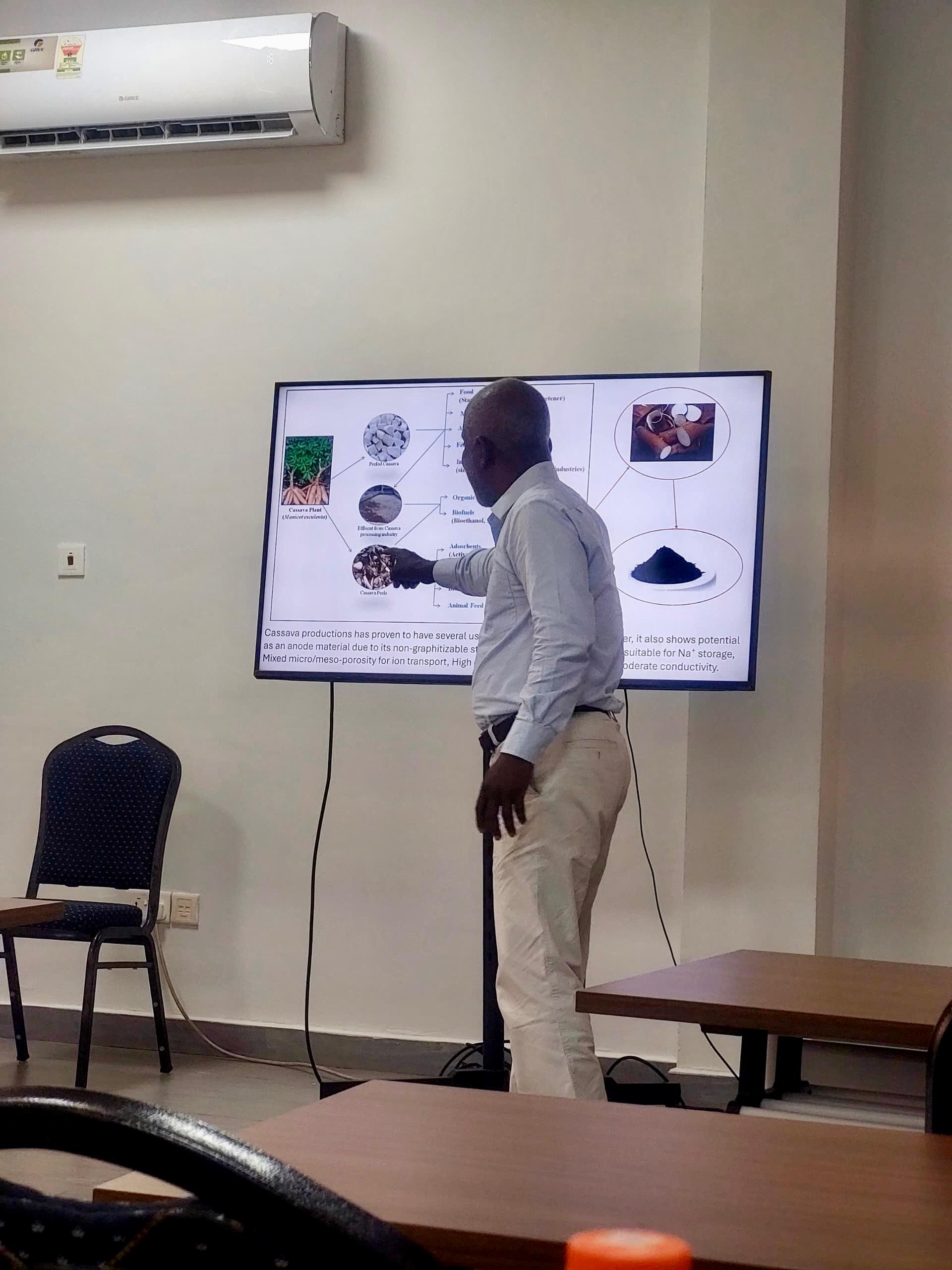
At the 19th International Conference on Advanced Materials (ICAM), Senior Research Fellow at TCC-CIMET, Michael Kweku Commeh, is making waves with a groundbreaking presentation that seamlessly blends science, sustainability, and local innovation.
His work highlights how cutting-edge research can drive practical solutions for communities, reinforcing TCC-CIMET’s commitment to technology transfer and industrial development in Africa.
In a session filled with researchers from across the continent, Michael unveiled his latest work: the development of sodium-ion batteries made from waste cassava peels.
The innovation demonstrates how everyday agricultural waste often discarded or burned can be transformed into a key material for clean energy storage.
This research taps into Ghana’s abundant cassava production, turning what is usually a by-product into a valuable carbon source for next-generation batteries. Sodium-ion technology offers a promising alternative to lithium-based systems, particularly for African nations looking for affordable, locally sourced materials.
Michael’s presentation highlighted how this breakthrough could contribute to energy access, circular economy solutions, and local manufacturing opportunities. By showing that cassava waste can power battery development, he is helping to redefine how natural resources and agricultural by-products can support Africa’s renewable energy future.
This research was conducted in collaboration with Imperial College London and co-authored by Hartley Niamh, Meruyert Nazhipkyzy, Eugene Sefa Appiah, and Magdalena Titirici.
This year’s conference is hosted by the University of Ghana in collaboration with the International Union of Materials Research Societies (IUMRS) and the African Materials Research Society (AMRS) as part of the 19th International Conference on Advanced Materials (ICAM).
Was this article helpful?
TCC-CIMET
AdminStay up to date with what's happening at TCC-CIMET and within the KNUST community
Related post:
- TCC-CIMET, DAAD explore digital pathways for circular construction in Africa
- TCC-CIMET, AESD Explore Collaboration to Strengthen Agricultural Technology Development in Ghana
- Prof. Agyare Assumes Chairmanship of TCC-CIMET Governing Board, Strengthening UNESCO, Ghana, KNUST Partnership
- Prof. Agyare Pledges to Transform TCC-CIMET and Strengthen Technology Transfer
- Precision Starts with Advanced CNC Machining
- TCC-CIMET Delivers Precision-Engineered Shaft for Legendary Foods' Coconut Shredder
- TCC-CIMET Hosts Japanese Scholars to Explore Collaboration on Technology Management and Skills Development for Artisans
- TCC-CIMET and Whitefalls Energy Explore Clean Energy Transportation Initiative for KNUST
- WiNE-KNUST, TCC-CIMET Celebrates International Women in Engineering Day with an Inspiring Seminar
- TCC-CIMET Hosts the African WEFE Nexus Summit 2026 Under the Trans Sahara Project